🏺 Cuneiform Sign Classifier
Classifying individual cuneiform signs (Sumerian/Akkadian) on 3D-rendered clay tablet images, using transfer learning — a digital humanities application connecting deep learning with paleography.
Live demo: cuneiform-sign-classifier.streamlit.app · GitHub Repository
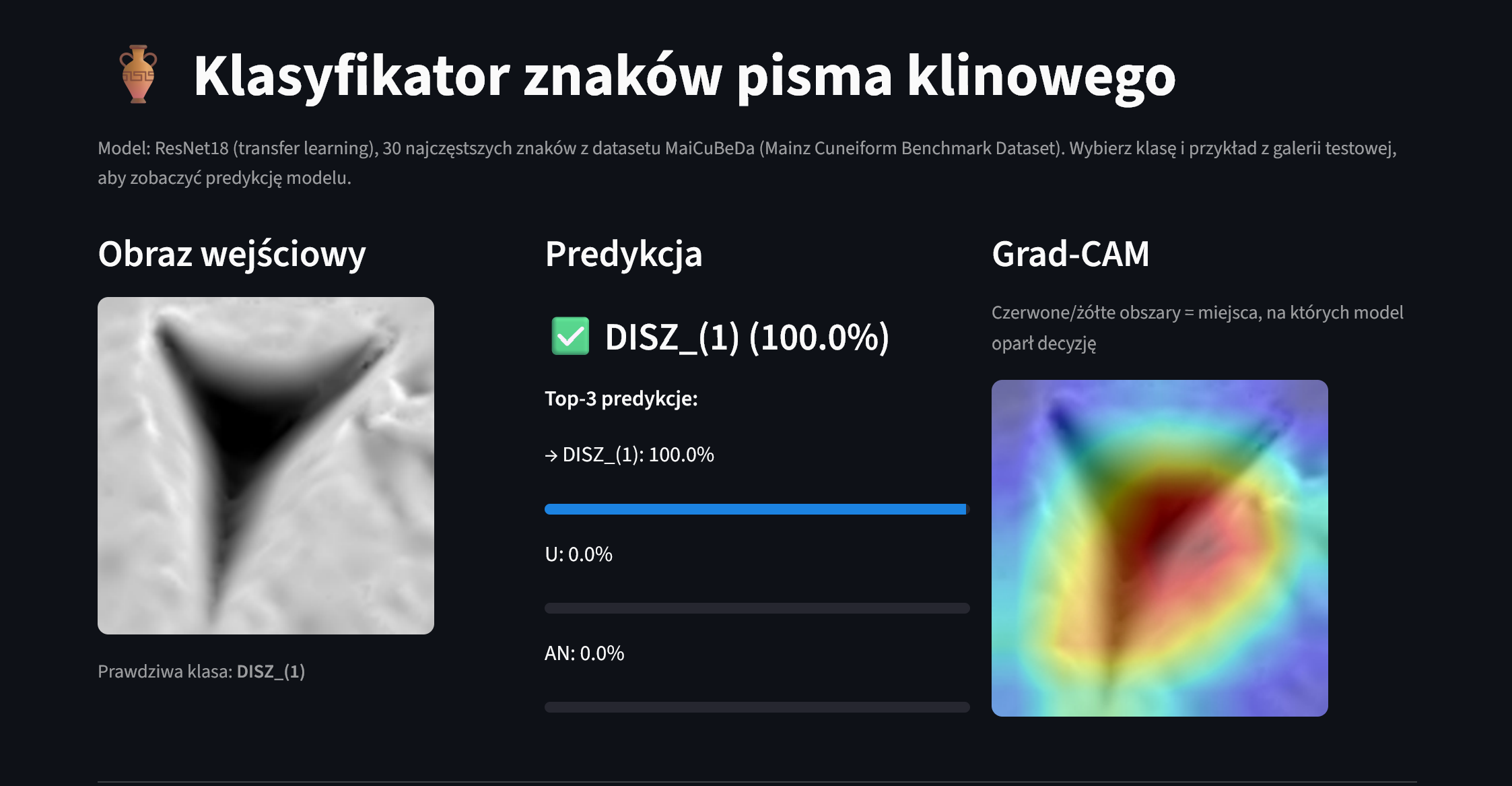 The Streamlit demo: pick a test example, see the top-3 predictions with confidence, and a Grad-CAM overlay showing which part of the sign the model based its decision on.
Why this project
Cuneiform is one of the oldest writing systems in the world and still an active area of digital humanities research. Instead of another generic image classifier, this project tackles a niche, genuinely challenging dataset: a long-tailed class distribution, inconsistent metadata, and a domain where a standard computer-vision trick (horizontal flip augmentation) is actually a methodological error — mirroring a cuneiform sign changes its identity.
Results at a glance
| Metric | Result |
|---|---|
| Number of classes | Top 30 most frequent signs |
| Test set | 1,699 sign images |
| Test accuracy | 90.4% (95 % Wilson CI 88.9–91.7 %) |
| Test macro-F1 | 0.896 |
| Model | ResNet18 (transfer learning), CPU-only |
| Dataset | MaiCuBeDa Hilprecht (28.7k annotated signs, CC BY-SA 4.0) |
What the evaluation showed
Paleographic drift of the sign U
Exploratory analysis revealed that the sign U (the number "10") has a physically different form depending on the historical period: a round indentation in the oldest tablets (ED IIIb, ca. 2500–2340 BC) vs. a clear triangular wedge in later periods — a documented paleographic phenomenon from an era when scribes partly used a round stylus for writing numbers.
The evidence points the same way in two independent analyses:
- Quantitatively: accuracy for
Uis 100% across every later period, but drops to 43% (3/7) specifically for the oldest period, ED IIIb. With n = 7 this is only indicative (95 % Wilson interval 16–75 %). - Geometrically: t-SNE on the model's 512-dimensional feature space shows the sign
Uforming two separate clusters corresponding to the two graphical variants — while a sign without this drift (ASZ) forms one coherent cluster.
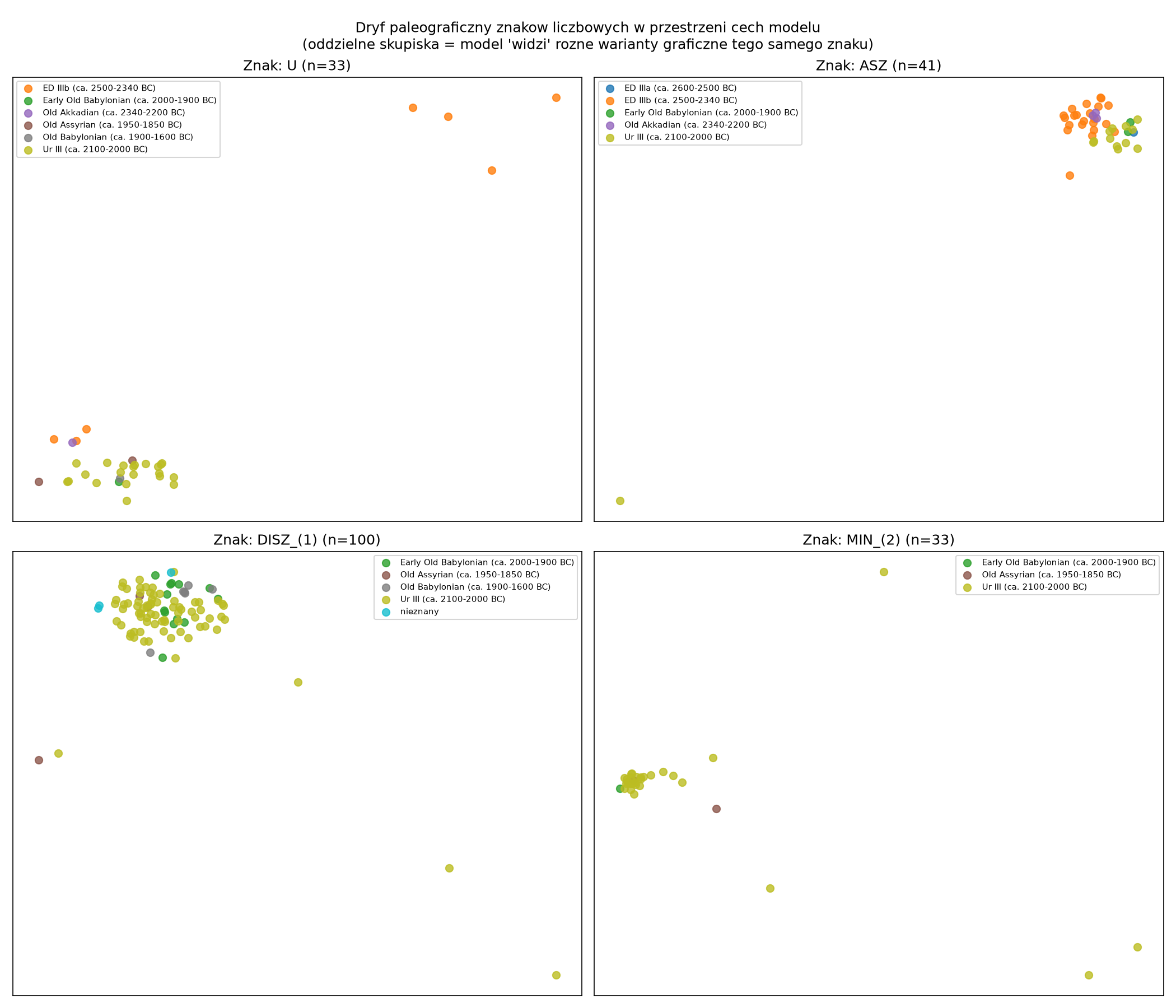 t-SNE visualization of the model's feature space for four signs.
U (top-left) splits into two clusters by historical period — the model "sees" the same graphical variation a paleographer notices visually — while ASZ (top-right) stays coherent.
The model was never told about paleography, yet its feature space separates the two variants of the sign, a documented change in how the sign was written over roughly 500 years. This is a side-effect of classification that points to something in the domain; with only 7 oldest-period examples it is a lead for an expert to check, not a finding.
Confusion matrix
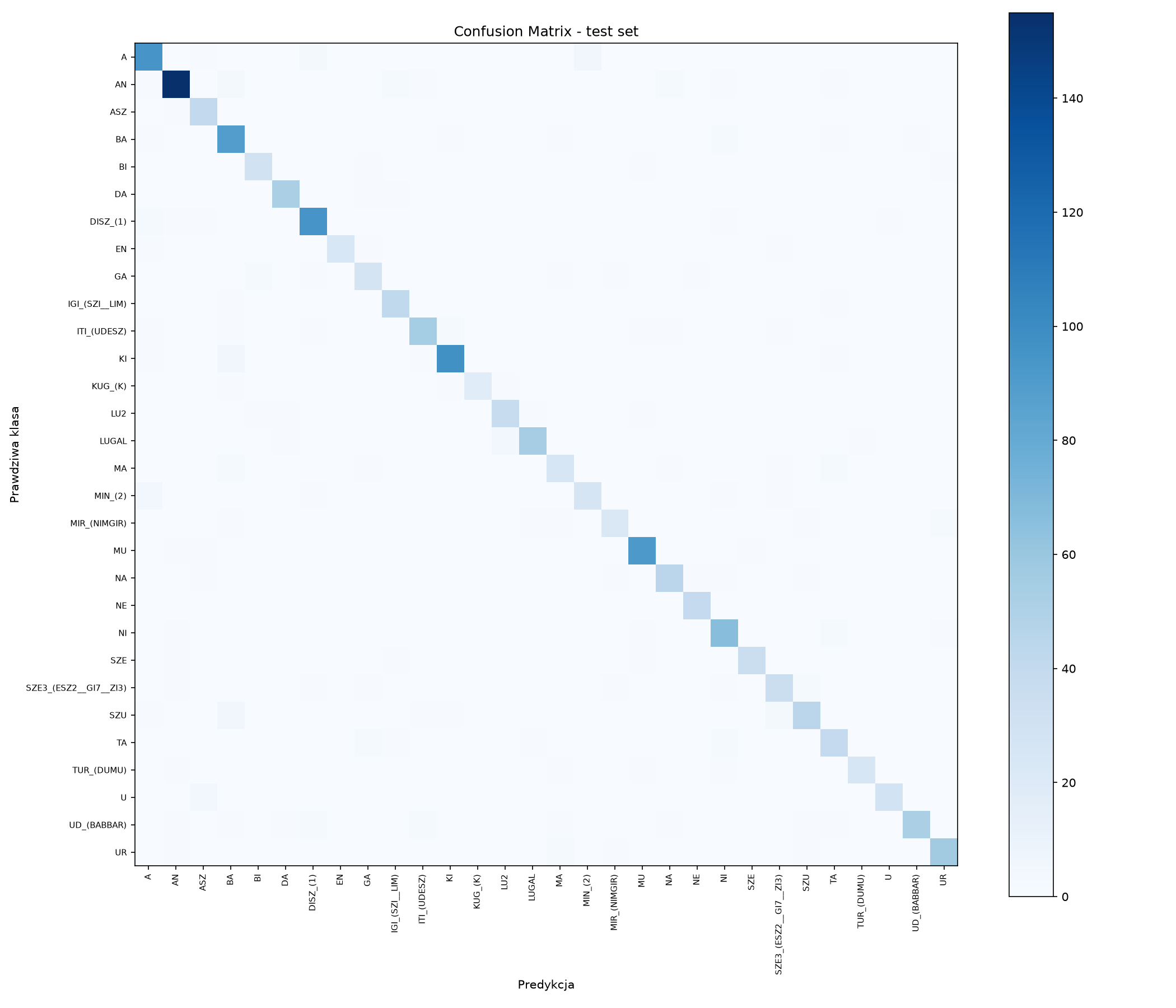 A clean diagonal — errors are rare and concentrated (e.g.
LUGAL→LU2, A↔MIN_(2)), explainable by visual similarity between the signs' graphical components rather than random noise.
Methodology
- Train/val/test split (70/15/15) grouped by tablet, not by individual image — the same sign from the same tablet never ends up in two splits at once. Checked by automated tests of the splitting code itself (synthetic tablets, run on every push in CI) plus 8 optional manifest checks on the real split (see Testing below).
- Class weights (inverse frequency) in the loss function to handle the ~5x imbalance between the most and least frequent of the top-30 classes.
- Model selected by macro-F1 on validation, not accuracy — to avoid favoring the most frequent classes.
- Augmentation without mirror flips. A standard
RandomHorizontalFlipwould be a methodological error here — mirroring a cuneiform sign changes its identity. Only small rotation (±8°) and light brightness/contrast jitter were used. - Transfer learning with partial freezing — ResNet18's early layers frozen, later layers and the classifier head trained, as a quality/training-time trade-off for CPU-only training.
- Data quality: the metadata CSV's filename field did not match the filenames in the published image archive (a dataset-versioning artefact). Filenames are parsed directly from disk, and each sign's transliteration is mapped to its class through a lookup table built from the metadata (923 unique readings, only 18 ambiguous, resolved by majority vote).
Testing
46 automated tests run on every push (GitHub Actions) together with a ruff lint check and a dependency audit. The suite uses only synthetic data: no dataset, no trained checkpoint, no network, so it runs in about ten seconds on a fresh clone.
- Data splitting and leakage: the code that builds the train/val/test split is tested on synthetic tablets (no tablet in two splits, every tablet assigned once, deterministic for a seed). The manifest of the real split is checked by 8 extra tests that run only when the dataset is present locally.
- Domain rule in augmentation: the training pipeline contains no mirror flips, because a mirrored cuneiform sign is a different sign.
- Model and Grad-CAM: output shape, the freeze policy (only
layer3/layer4/fcreceive updates), Grad-CAM shape/range on a random-weight model, hooks removed after every prediction. - Safe checkpoint loading: all
torch.loadcalls useweights_only=True; a test builds a malicious checkpoint and proves that its payload does not run (with a control showing the unrestricted loader would run it). - App: Streamlit
AppTestrenders the app, lists classes, shows top-3 and the low-confidence warning.
Not covered (stated honestly): the accuracy of the real trained model (the numbers come from running evaluate.py locally on the full dataset), the visual quality of Grad-CAM, the Hugging Face download and the Docker build.
Statistical caveat: the ED IIIb result for the sign U is 3 of 7 (95 % Wilson interval 16–75 %), so it is an indication, not a proof.
Limitations
- Only the top-30 classes — the full cuneiform sign inventory has hundreds of signs with a strong long tail (93 classes have only 1 example in the entire dataset).
- Imbalance across historical periods (64% of the data is from the Ur III period) limits generalization to older graphical variants — directly documented via the sign
Uabove. - Classification, not detection — the model assumes the sign has already been cropped from the tablet.
Tech stack: PyTorch, torchvision (ResNet18), Grad-CAM (own implementation), t-SNE, Streamlit, Hugging Face Hub, pytest, ruff, GitHub Actions, Streamlit Community Cloud.
Related: for the same leakage-aware thinking on microscopy images (near-duplicate clusters instead of tablets, plus an information-bar shortcut test and calibration), see the SEM Nanostructure Classifier. For a project on detecting and localizing objects — not just classifying an already-cropped one — see People Counter, which uses YOLOX-nano object detection plus multi-object tracking. Another ResNet18 transfer-learning classifier is Emotion Recognition: there the label noise and class imbalance of FER-2013 are the main difficulty, and the result is compared honestly against a from-scratch CNN baseline.