🔍 SEM Nanostructure Classifier
A classifier for scanning-electron-microscopy (SEM) images of nanostructures, built to answer one question: how much of the reported accuracy is real, once near-duplicate leakage and instrument shortcuts are controlled for?
Live demo: sem-nanostructure-classifier.streamlit.app · GitHub Repository · Weights and model card (Hugging Face)
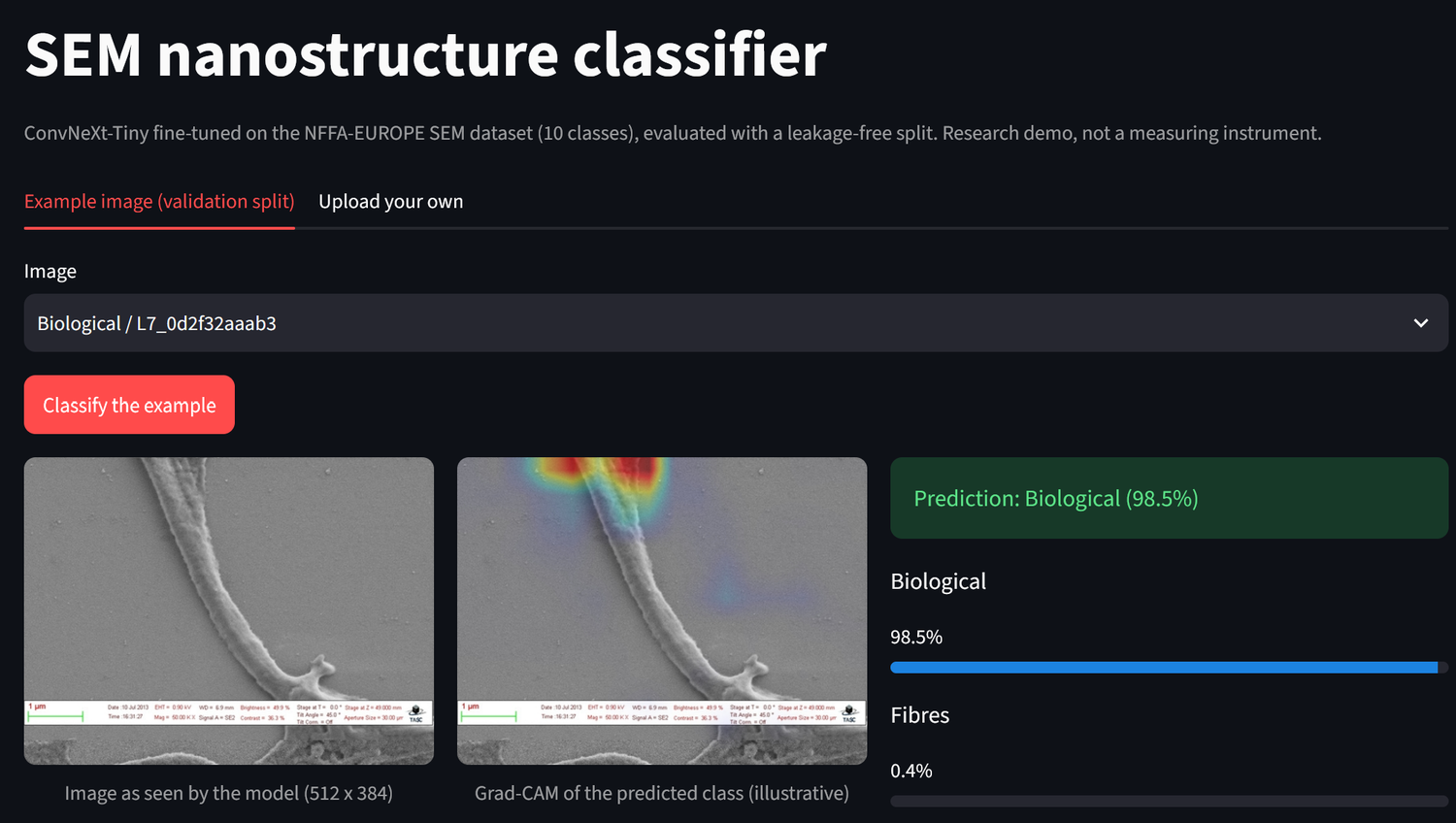 The Streamlit demo: pick a validation example or upload an image, see the top-3 classes with calibrated probability, an "uncertain" flag below a threshold chosen on validation, and an illustrative Grad-CAM.
Why this project
Image classifiers on microscopy data often report very high accuracy that does not survive a closer look: the same sample photographed several times lands in both train and test, and the instrument's information bar can carry the label. Instead of chasing a leaderboard score, this project fixes the evaluation rules in a written specification before any code, and then reports what is and is not established — including the negative and inconclusive results.
Results at a glance
Test split, group-aware (near-duplicate clusters kept together), mean of 3 seeds:
| Model | Macro-F1 (95% CI over clusters) | Accuracy | ECE raw → calibrated |
|---|---|---|---|
| ConvNeXt-Tiny | 0.956 [0.939, 0.966] | 0.972 | 0.024 → 0.006 |
| ResNet-50 | 0.944 [0.924, 0.957] | 0.965 | 0.024 → 0.009 |
Dataset: NFFA-EUROPE "100% SEM Dataset", 10 classes, 20,837 images after removing 332 exact duplicates (CC BY). ConvNeXt-Tiny is ahead of ResNet-50 in every comparison, but this was not tested formally.
What the evaluation showed
- Leakage. A random split gives macro-F1 0.968 (ConvNeXt-Tiny) against 0.956 on the group-aware split, a gap of 1.3 pp with the same sign in both backbones; the intervals include or touch zero, so the gap is not established. In the random split 23.4% of test images have a near-duplicate "cluster-mate" in train; these are classified at 99.6-99.9% accuracy, the rest at 96.4-97.2%.
- Info bar. Removing the bottom 18.75% of every image (where the bar sits) costs 1.4 pp macro-F1 on test (interval +0.4 to +2.3), removing the same amount from the top costs nothing. The validation split shows no drop. Reading: no evidence of a shortcut that carries the classification; a contribution of about 1-1.5 pp in the small classes cannot be excluded.
- Confidence. Temperature scaling (T = 3.3) cuts the expected calibration error from 0.024 to 0.006. Abstaining below a threshold chosen on validation keeps 94% of test images at 99.2% accuracy (overall 97.2%) and catches about 71% of the errors, but it abstains mostly on rare classes (44% of Porous_Sponge, 37% of Films_Coated_Surface).
Methodology
- Specification first.
SPEC.mdfixes the data-security and leakage rules, the split procedure and the test protocol before the code exists; every change is logged in it with a date. - Near-duplicate-aware splits. Groups are connected components of cosine similarity ≥ 0.94 between frozen ResNet-50 features; whole clusters go to one of train/validation/test (70/15/15). A test asserts that no cluster crosses splits; thresholds 0.90 and 0.98 serve as a sensitivity check.
- Fixed configuration, no tuning. One training recipe for every run, 3 seeds per model, epoch chosen on validation macro-F1.
- Test evaluated once. Each checkpoint touches the test split exactly once, after the configuration was frozen; nothing was changed after seeing test results. The calibration and abstention analysis is post-hoc on stored test logits, with all parameters fitted on validation only.
- A bug caught before testing. The first group-aware split put almost all large clusters into validation and test. It was noticed from the validation loss, the split was fixed and all group-aware runs were repeated; the details are in the spec.
Engineering
- Deployment: Streamlit Community Cloud; the weights live on the Hugging Face Hub and are downloaded on the first start and verified against a recorded sha256 (a mismatch means no model is loaded). Uploads are processed in memory only, nothing is stored or logged.
- Repository guard: a CI check fails if weights, archives, keys or files over 5 MB are ever committed.
Testing
Automated tests run on every push and pull request (pytest and ruff in GitHub Actions). Tests that need PyTorch are skipped without it, and CI runs both variants. No dataset and no trained checkpoint are needed.
What is verified
- Splits: the near-duplicate groups are built correctly and no cluster crosses the train, validation and test splits.
- Metrics and calibration: the evaluation and calibration code.
- Inference: the prediction path of the demo.
- Download integrity: the weights are accepted only when the sha256 matches.
- Repository hygiene: no weights, archives, keys or large files tracked.
Not covered
- The published numbers. Training and the one-time test evaluation ran in Kaggle notebooks that are not in the repository, so CI does not recompute any result; every number comes from a logged run in
reports/. - Behaviour on images from other instruments or laboratories (there is no external test set).
Limitations
- One lab, one dataset, no external test set; the group definition (embedding similarity) is a proxy for "same sample".
- Confidence intervals describe the test sample, not the variation between trainings; with 3 seeds, differences of about 1 pp are at the noise level of single runs.
- Small classes have 22-46 test images, so per-class numbers move by several points with one image.
- The demo has no out-of-distribution detector: any image, including a photograph, gets one of the 10 SEM classes.
- Two ablations from the original plan (class weights, stronger augmentation) were not run.
Tech stack: PyTorch, torchvision (ConvNeXt-Tiny, ResNet-50), Grad-CAM, Streamlit, Hugging Face Hub, pytest, ruff, GitHub Actions.
Related: the same discipline of group-aware splits and honest error analysis, applied to a different domain, is in the Cuneiform Sign Classifier (split by tablet, not by image). A smaller transfer-learning classifier with an honest baseline comparison is the Emotion Recognition project. The nanostructures behind the SEM classes connect to the Carbon Nanotube Visualizer.