🚶 People Counter
Local, CPU-only person detection and directional counting — deep-learning object detection plus multi-object tracking, wrapped in an interactive Streamlit app.
Live demo: people-counter-yolox.streamlit.app · GitHub Repository

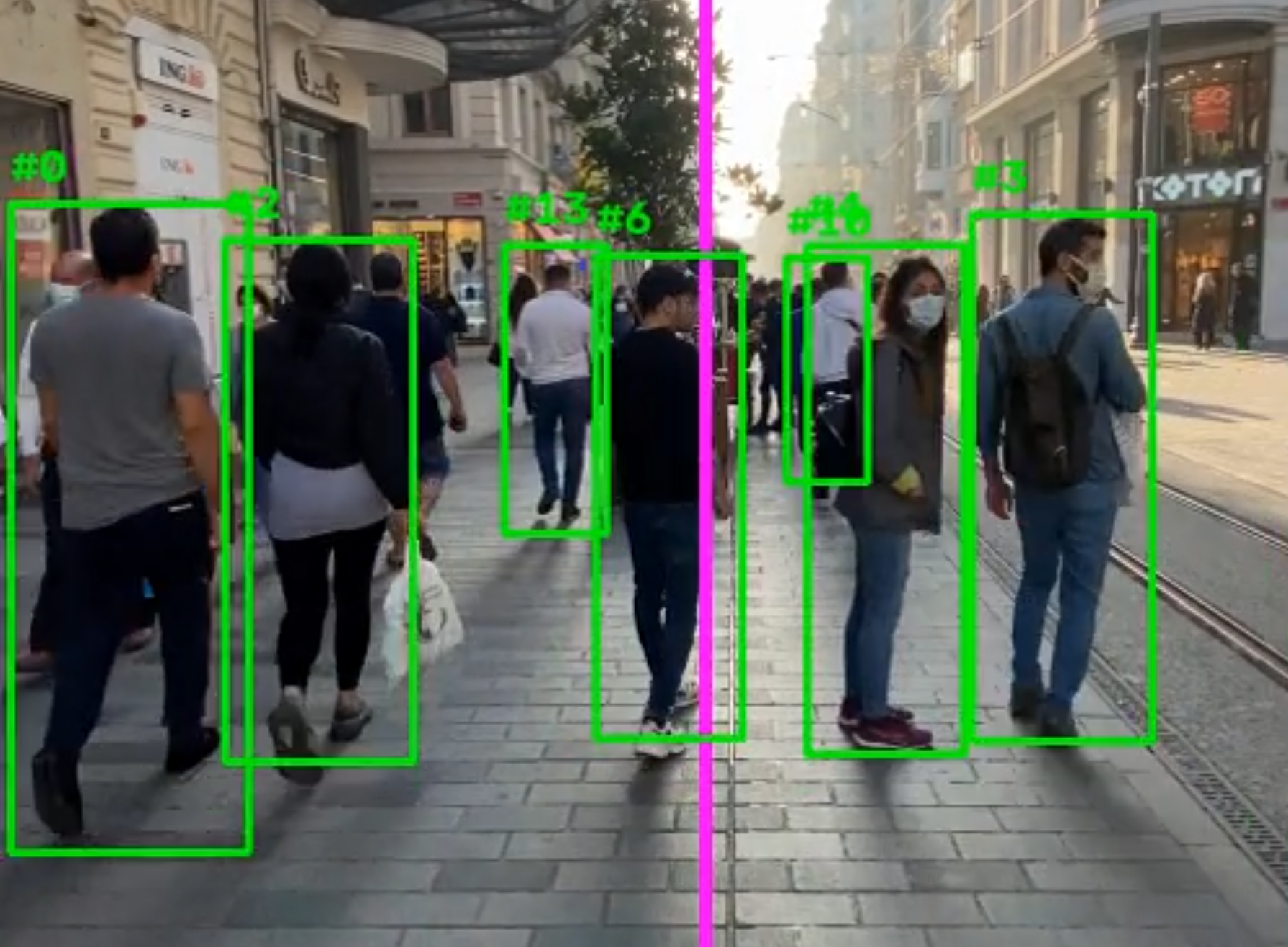 Video mode — each tracked person keeps a stable ID across frames; the magenta line is a configurable counting gate (IN / OUT / NET).
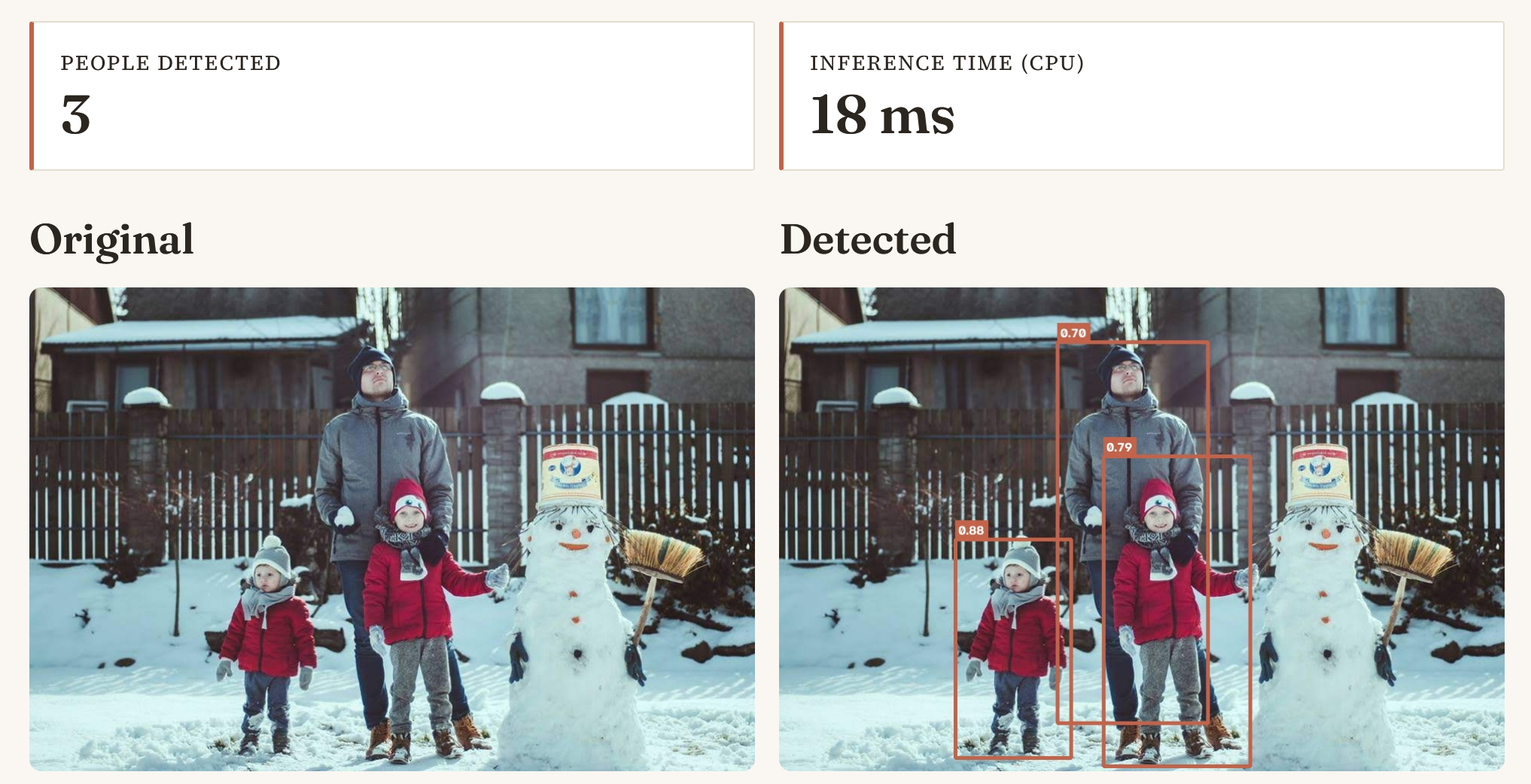 Image mode — one-shot detection with per-box confidence scores.
Why this project
The portfolio previously had a "Person Counter" that was actually a Haar-Cascade face counter mislabeled as a person counter — it couldn't count anyone facing away from the camera, and wasn't a real detector at all. I rebuilt it from scratch as an actual person detector (YOLOX-nano, deep learning) with multi-object tracking, instead of quietly patching the old one.
Together with the Erythrocyte Shape Analyzer, this shows two different ends of my computer vision work: classical image processing there (Otsu thresholding, contour detection, ellipse fitting), versus a modern deep-learning object detector plus a multi-object tracker here. It's also a useful contrast with the Cuneiform Sign Classifier: that project classifies an already-cropped image, while this one has to first find and localize every person in the frame before anything else can happen. The Emotion Recognition project sits one step further down that pipeline: it takes an already-detected face and classifies the expression with a fine-tuned ResNet18 (and still uses a Haar Cascade for the detection step, the technique the old Person Counter was built on).
What it does
- Image mode — upload a photo, get back per-person bounding boxes with confidence scores and a total count.
- Video mode — upload a clip, draw a counting line anywhere in the frame, and get IN/OUT/NET counts of people crossing it, with each tracked person keeping a stable ID across frames.
A bundled sample image and video let a visitor try both modes without needing their own file.
How it works
- Detection: YOLOX-nano (COCO-pretrained, ONNX export), run locally via ONNX Runtime on CPU. Only the "person" class is kept.
- Tracking (video mode):
trackers'sByteTrackTracker, associating detections frame-to-frame by IoU. - Line-crossing counting: a small, pure-Python module that watches which side of a user-drawn line each tracked person's centroid is on, and counts a crossing whenever that side flips — independent of any CV/ML code, unit-tested with synthetic positions, no video or model weights required.
Measured accuracy
Evaluated against a real labeled sample (62 people-containing images from the public coco128 dataset), matching detections to ground-truth boxes at IoU ≥ 0.5 — numbers are regenerated from scratch by evaluate.py, not estimated:
| Metric | Value |
|---|---|
| Precision | 0.825 |
| Recall | 0.520 |
| F1 | 0.638 |
| CPU inference speed | ~95 FPS (10.5 ms/image) |
Data security & privacy
All inference runs locally — no image or video is ever sent to a third-party API. Uploaded video is written to a private temp file only because OpenCV needs a real file path to read it, and that file is deleted immediately after processing, even if something goes wrong. Nothing uploaded is logged, stored, or kept between requests.
Testing
Automated tests run on every push and pull request (pytest in GitHub Actions). All tracking and line-crossing logic is tested with synthetic, injectable detectors, so the suite needs no video, no images and no model weights.
What is verified
- Line-crossing counting: the pure-Python counter is driven with synthetic positions: a crossing is counted when the side of the line flips.
- Video pipeline: the wiring of detector, tracker and counter is tested with a fake detector (
FakeDetector).
Not covered
- Detection accuracy in CI. Precision, recall and speed are measured separately by
evaluate.pyon the public coco128 sample; CI does not run it. - Counting accuracy on real video. The IN/OUT counts were not compared with manually counted ground truth.
- The ONNX model itself, real video files and the Streamlit interface in a browser.
Limitations
- Recall is the honest weak point. YOLOX-nano is the smallest model in its family (built for speed over accuracy) and struggles most on dense crowd scenes with many small, overlapping people. A larger YOLOX variant would trade some CPU speed for materially better recall.
- The counting line only works if it's oriented against the actual direction of motion in the video. A camera looking across a path (people moving left/right) needs a vertical line; a camera looking down a corridor (people moving toward/away from camera) needs a horizontal one. There's no universally-correct default — this is why the line is configurable with sliders rather than fixed.
- Free-tier CPU-only hosting means very long or very high-resolution video uploads are capped (frames are downscaled before processing, and there's a hard length limit) to avoid exhausting the host's memory.- The evaluation uses a small public image sample (coco128), not surveillance-style video, so the accuracy figures describe detection on still images and say nothing about counting on a specific camera.
Tech stack: Python, Streamlit, ONNX Runtime, OpenCV, trackers (ByteTrack), supervision, imageio-ffmpeg, pytest, GitHub Actions. License: code MIT, YOLOX-nano weights Apache 2.0.