🎯 CV Job Matcher
A Streamlit app that ranks job offers against a CV with OpenAI embeddings, with a privacy-first data flow and a test suite that needs no API key.
GitHub Repository · Live demo (Streamlit; the app sleeps when idle and wakes up with one click)
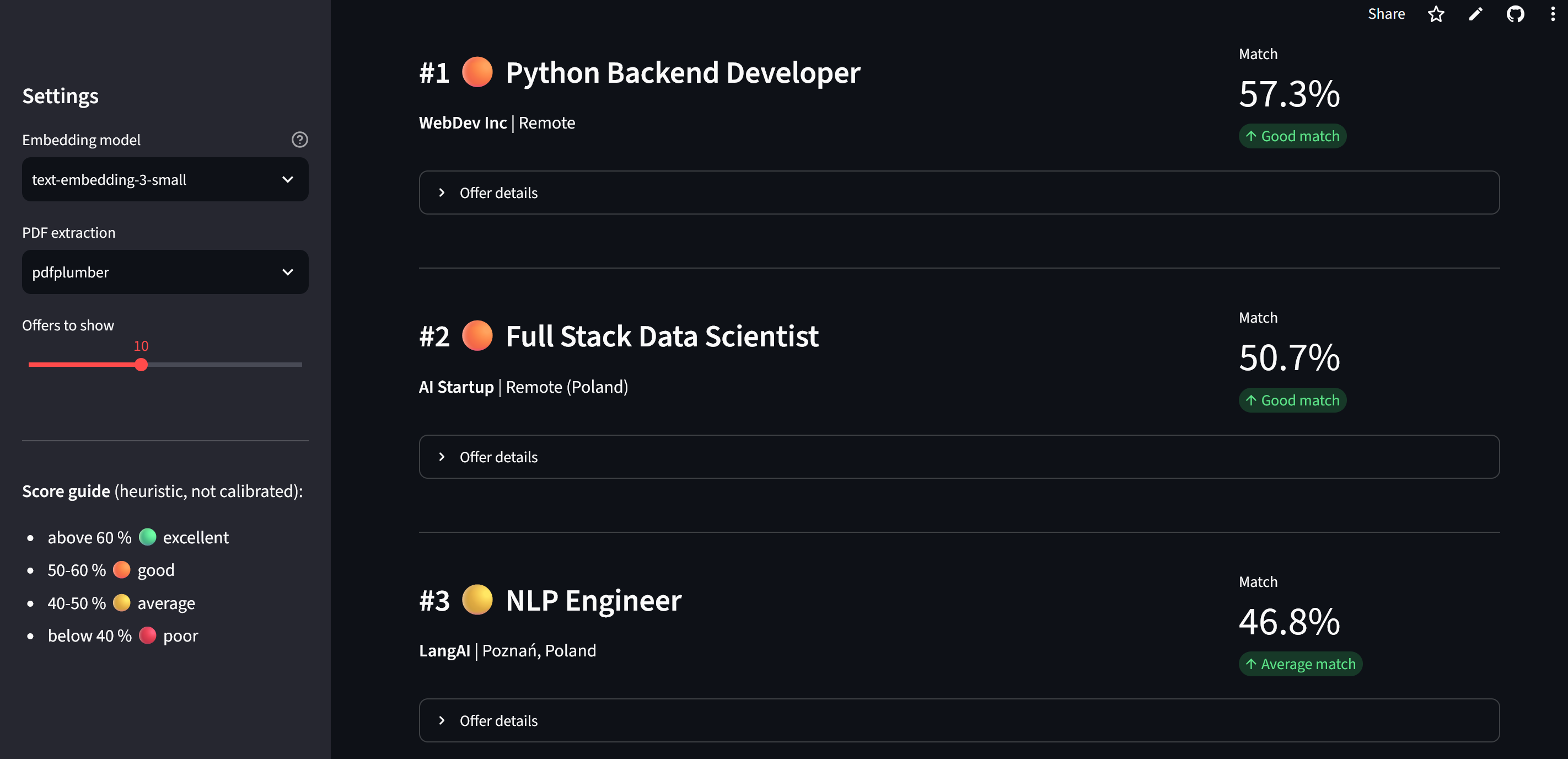 Ranking of the bundled fictional sample offers for one CV. Scores are cosine similarities of OpenAI embeddings; the bands are heuristic.
Why this project
Reading dozens of job offers against your own CV is slow, and keyword search misses offers that describe the same skills in other words. The idea: condense the CV into a short list of skills, embed it together with the offers and rank by similarity. The project is a demonstration of an embedding pipeline, not a validated recommender: there is no labelled relevance data, so match quality has not been measured, and the 60/50/40% score bands are heuristic. What it shows is the engineering around the model: batching, caching, failure handling, privacy and tests. It was built bottom-up, with three exploratory notebooks, then the application, then a hardening release (privacy, correctness, tests, CI) driven by a written specification.
Results at a glance
A CV against 5 fictional sample offers (exploratory notebook). This shows that the pipeline runs and ranks plausibly, not how good it is on real data:
| Rank | Job title | Match score |
|---|---|---|
| 1 | Senior Machine Learning Engineer | 61.37% |
| 2 | AI Research Engineer | 49.76% |
| 3 | Data Scientist | 49.53% |
| 4 | Python Backend Developer | 49.10% |
| 5 | Junior Python Developer | 44.70% |
text-embedding-3 similarities are compressed (rarely above 0.7), so the percentages are relative.
What the evaluation showed
- A silent wrong ranking was found and removed. The first version skipped an offer whose embedding request failed but kept it in the list, so
zip(jobs, similarities)attached scores to the wrong offers. Embedding is now all-or-nothing: on failure the app shows an error and no ranking, andrank_jobsraises if the two lists differ in length. - Condensing the CV helped in a small comparison. On 5 fictional offers the condensed version ranked the expected role first. This is an observation, not a proven effect.
- An earlier version exposed other people's data. It could store uploaded CVs in cloud storage and list recent file names to all visitors. The code was removed entirely.
Methodology
[Upload PDF] → in-memory text extraction (pdfplumber / pypdf)
      ↓
[gpt-4o-mini] → skills summary (~400 characters)
      ↓
[text-embedding-3-small] → CV vector (1536-dim)
      ↓
[The Muse API / cached file / bundled sample offers]
      ↓
[batched embeddings, up to 100 texts per request, cached 1 h]
      ↓
[cosine similarity (NumPy)] → ranked offers + CSV export
- Why condense the CV? A full CV contains dates, formatting and project prose that dilute the vector.
- Batching and caching: one request per offer meant 100+ API calls per click; offers are now embedded in batches of up to 100 and cached for an hour per offer set.
- First start without the network: the app uses the cached file or the bundled fictional sample offers (and says so); the network is used only on Refresh DB.
- External data is untrusted: only
http(s)links are rendered, and CSV cells that start with=,+,-or@are neutralised against spreadsheet formula injection.
Data and privacy: what happens to your CV
| Step | What happens |
|---|---|
| Upload | PDF read in memory (max 5 MB, first 10 pages); never written to disk |
| Skills extraction | CV text (max 20,000 characters) is sent to OpenAI; the UI says so |
| Matching | only the short skills summary is embedded |
| Storage | nothing is stored; the app has no storage code and no cloud-storage dependency |
Testing
38 automated tests run on every push and pull request (GitHub Actions, Python 3.11, plus ruff). They need no API key and no network: OpenAI is replaced by a deterministic fake client.
What is verified
- Ranking: ordering, length mismatch raises, input not mutated, rating thresholds.
- Embeddings: batching (calls = ceil(n/100)), row i belongs to text i even when the API returns items out of order, a failed request raises instead of returning partial results, long and empty texts.
- PDF: text extraction from generated PDFs with both libraries, garbage input, page limit.
- Job data: HTML stripping, payload formatting, de-duplication, network errors,
javascript:links dropped, cache and sample fallback. - Privacy rules: no "Recent CVs" in the UI, no storage option, and no storage module or cloud-storage dependency in code, requirements, workflows or settings.
- App: Streamlit
AppTestruns the whole script, including matching end to end and "no ranking on embedding failure". - Repository hygiene: no
.env, PDF or generated files tracked; no e-mail address or phone number in tracked notebook outputs.
How the tests were checked: re-introducing the length-mismatch bug, swallowing a failed embedding batch, removing the CSV neutralisation, bringing back the CV list or adding cloud-storage code each make the suite fail.
Not covered: the real OpenAI and The Muse APIs, match quality (no ground truth), and uploading a file through the browser widget.
Limitations
- Match quality is unmeasured, and the notebook comparison rests on 5 fictional offers.
- The Muse API returns mostly US-centric offers and only the first page (20) per search term.
- The CV text is processed by a third party (OpenAI); this is stated in the UI.
Tech stack: Python 3.11, Streamlit, OpenAI API (gpt-4o-mini, text-embedding-3-small/large), NumPy, pandas, pdfplumber, pypdf, The Muse API, pytest, ruff, GitHub Actions, Dependabot.
Related: the Scientific Research Agent is another OpenAI-based application tested with a scripted fake model; it also carries a measured evaluation, which this project lacks. The Carbon Nanotubes RAG System uses embeddings with a measured answer quality (RAGAs).